
Published March 16, 2026
Old Photos Were Never Designed for a Digital World
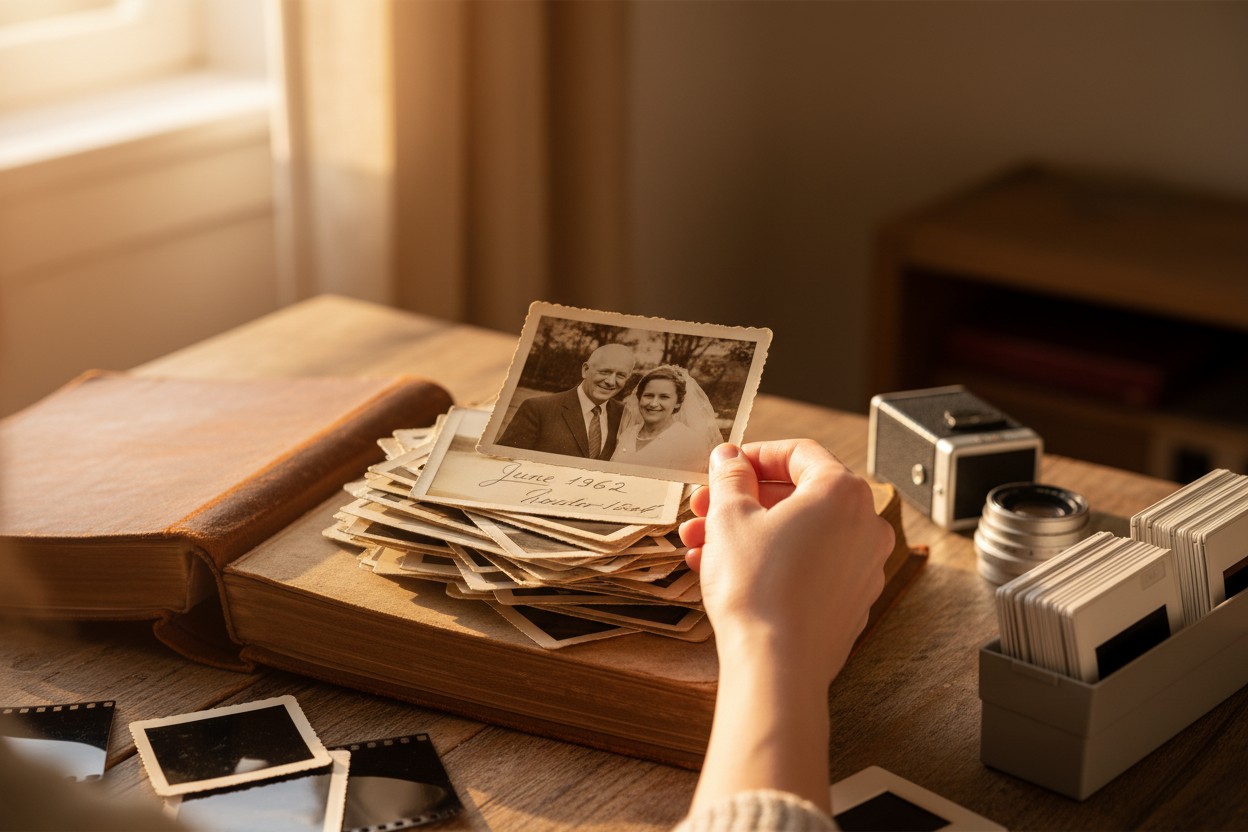
There’s a certain magic to opening an old shoebox or a heavy, leather-bound album. It’s a sensory experience. The faint, dusty smell of aging paper and chemicals, the soft rustle as you turn a page, the satisfying weight of a stack of prints in your hand. You pull one out—a glossy, dog-eared snapshot of your grandparents on their wedding day, their smiles frozen in a creamy, off-white frame. You turn it over and find a date, “June 1962,” written in your grandmother’s elegant cursive. This single object is more than an image; it’s a tangible artifact, a direct link to a moment you never witnessed but feel connected to nonetheless.
Now, think about your phone’s camera roll. Thousands of images, perfectly sharp, brightly colored, all neatly organized by date and location. You can swipe through a hundred photos in a minute, share them with the world in seconds, and store them in a cloud that feels infinite. It’s efficient, convenient, and utterly different. This stark contrast highlights a fundamental truth we often overlook: old photos were never designed for a digital world. They were born of a different philosophy, a different technology, and a different way of experiencing memories. Understanding this disconnect is the key to not only appreciating their unique charm but also to preserving them thoughtfully for the future.
The Tangible Soul of an Analog Photograph
Before a photograph was data, it was an object. Each print was the result of a physical and chemical process. Light hit a strip of celluloid coated in a silver halide emulsion, creating a latent image. In the darkroom, a bath of chemicals brought that image to life, which was then projected onto light-sensitive paper. The result was a physical artifact with its own unique characteristics.
Consider the texture of the paper—was it glossy, matte, or perhaps the pebbled texture of a lustre print? Think about the format. The iconic white border of a Polaroid, which developed right before your eyes, was a frame within a frame. The square format of an Instamatic camera or the panoramic shot from a disposable one—each tells a story about the technology of its time. These photos have physical properties that a JPEG file simply cannot replicate. They can be creased, faded, stained with water, or torn. While we see this as damage to be fixed, it’s also a part of their history. That coffee ring on a photo from a 1970s breakfast nook tells its own story.
Furthermore, the back of the photo was just as important as the front. It was the designated space for context. Names, dates, locations, and heartfelt messages were scribbled down to ensure the memory wasn't lost. This "metadata" was entirely human, prone to smudging and fading, but filled with personality. A digital file has EXIF data—camera settings, GPS coordinates, timestamps—but it lacks the soul of a handwritten note that reads, “Me and Sally, summer of ‘88. Best friends forever!”
The Art of Scarcity and Intention
In the age of film, photography was an act of intention. A roll of film typically held 24 or 36 exposures. Every single click of the shutter had a cost, both in terms of film and the eventual price of developing. You couldn’t just snap a hundred photos of a sunset, hoping one would turn out well. You had to think. You had to compose your shot, wait for the right moment, and hope you captured it.
This scarcity bred a different kind of photographer in all of us. We were more deliberate. We saved our precious exposures for the big moments: birthdays, holidays, graduations, and vacations. The everyday moments were less frequently captured, which makes finding a candid, ordinary shot from decades past feel like discovering a rare gem. The anticipation was also part of the experience. You’d finish a roll and drop it off at the photo lab, waiting days or even a week to see the results. The moment you finally tore open that envelope of prints was a genuine event, filled with the thrill of seeing which moments you successfully immortalized and which were lost to blur or a thumb over the lens.
Today, we live in an era of photographic abundance. We can take a thousand photos in a day and delete 990 of them without a second thought. While this allows us to capture everything, it can also devalue the individual image. When every moment is documented, which moments are truly special? The limitations of analog photography forced us to curate our lives in real-time, and the resulting photos carry the weight of that deliberate choice.
The Challenge of Translation: Bridging Two Worlds
Given that these analog treasures were not made for our digital screens, the process of bringing them into the 21st century presents a unique set of challenges. This isn’t just about converting an image from physical to digital; it’s about translating its essence without losing the story it tells.
Many of us have tried the obvious methods with frustrating results:
- The Flatbed Scanner: While capable of high-quality results, it’s a slow, laborious process. Scanning an entire album one photo at a time can take a whole weekend, and the bulky hardware is a far cry from the sleek devices we use daily.
- Taking a Photo of a Photo: This is the quickest method, but it’s fraught with peril. Glare from overhead lights, distorted angles (keystoning), and shadows from your own phone often ruin the final image, creating a poor imitation of the original.
This is where the process of digitization becomes an art in itself. It requires tools that understand the nature of the original artifact. Modern tools, however, are designed to tackle this very problem. For instance, when you use an app like Photomyne to scan, it’s not just capturing a single image; it’s using AI to intelligently detect the boundaries of multiple photos laid out on a page, automatically cropping and separating them into individual digital shots. It corrects the perspective, and its color restoration features can breathe new life into faded prints, attempting to faithfully translate that physical memory into a vibrant, high-quality digital format that feels true to the original. This approach respects the source, aiming to preserve rather than simply copy.
Creating a New Kind of Album for a New Generation
Once you’ve successfully bridged the gap and digitized your old photos, you haven’t replaced the originals. You’ve given them a second life. The shoebox in the attic remains the primary artifact, but its contents are now liberated from their physical prison. They are no longer susceptible to fading, water damage, or being lost in a move. They are backed up, secured, and, most importantly, ready to be shared.
This is where the digital world offers a new kind of magic. You can:
- Share Instantly: That beautiful photo of your great-grandparents can be sent to cousins across the world in an instant, sparking conversations and connecting family members.
- Add Context Anew: You can now digitally add the stories and names that were written on the back, ensuring that crucial context is permanently attached to the image file for future generations.
- Create New Narratives: You can create digital slideshows for family reunions, mix old photos with new ones to show how a family has grown, or even print new, high-quality photo books that combine the best of the past and present.
Old photos were not designed for a world of pixels, clouds, and instant sharing. They were designed to be held, to be passed around a living room, to age with us. Their beauty lies in their imperfections, their scarcity, and their physicality. But by carefully and thoughtfully translating them into the digital realm, we are not erasing that history. We are ensuring it survives. We are taking the quiet, tangible memories from the shoebox and giving them a new, louder voice, allowing them to be seen, shared, and cherished in ways our ancestors could never have imagined.